Emergency Garage Door Repair Near Me: What West Hollywood Homeowners Should Do First
The first thing to do when your garage door fails is figure out whether you actually have an emergency or just a very annoying inconvenience. In most cases, you can secure the door manually within a few minutes and call for a standard-rate repair in the morning. If you’d rather not touch anything, call (833) 467-4118 and we’ll walk you through it over the phone.
We’ve pulled enough doors open in this city to know that a stuck panel at 11 PM feels like a crisis. But here’s what most homeowners don’t realize: a significant percentage of those late-night calls end up being standard repairs that could have waited until 8 AM, once the door was manually secured. The difference between paying emergency rates and standard rates often comes down to what you do in the first 15 minutes.
West Hollywood has its own set of variables here. Street-facing garages on the flats near Santa Monica Boulevard have different security exposure than gated carports in the Norma Triangle or the multi-level structures off Kings Road. Your first move depends on where you are, what position the door is stuck in, and whether you can still get your car out. Let’s walk through this in order.
Start With a 60-Second Safety Triage
Before you call anyone, answer three questions. This takes less than a minute and it changes the entire conversation you’ll have with a repair company.
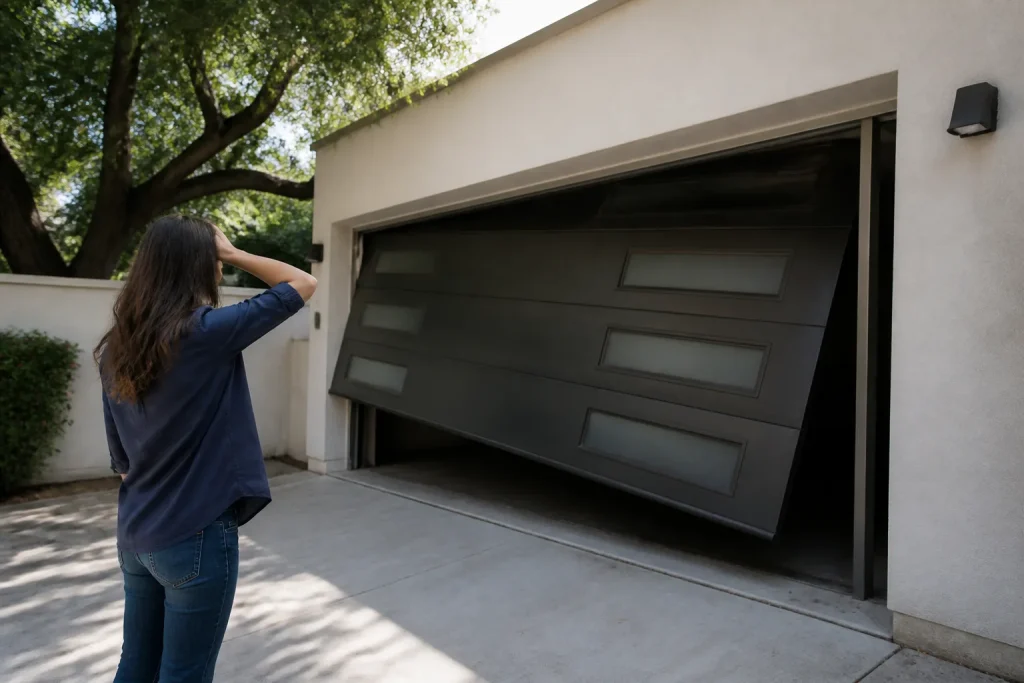
One: Is the door stuck open, closed, or somewhere in between? An open door is a security issue, especially in West Hollywood neighborhoods where garage interiors are visible from the street. A closed door that won’t open is usually just a scheduling inconvenience. A door stuck halfway is both, and it’s also a hazard if you have kids or pets moving through the space.
Two: Can you still get your car out? If the door is closed and your car is inside, you’re dealing with a vehicle-trap situation. That’s a legitimate emergency if you need the car for work or school the next morning. If the car is parked on the street and the garage is just storage, the urgency drops considerably.
Three: Did you hear a loud bang or snap before the door stopped moving? A sudden noise usually means a spring broke. In West Hollywood’s older buildings, where garage hardware has been in place since the 1980s or earlier, torsion springs fail regularly. When a spring goes, the door becomes extremely heavy to lift manually, and operating it with a broken spring can damage the opener motor or the panels themselves. This is one situation where you should not force the door.
Here’s the quick triage table we use with callers:
- Door open + street-facing garage + no way to secure it: Treat as a security emergency. Call tonight.
- Door open + gated or enclosed garage + can close manually: Secure it and book a morning appointment.
- Door closed + car inside + you need the car: Emergency call.
- Door closed + car outside + garage is storage: Book standard service tomorrow.
- Loud snap + door won’t move properly: Broken spring. Call a pro and don’t operate the door.
The point of the triage isn’t to talk you out of calling. It’s to make sure the call you make matches what you actually need. Every minute you spend knowing whether it’s a spring, a cable, an opener, or a sensor issue saves you money on the phone call itself.
How to Manually Release and Secure Your Door Without Making Things Worse
Every automatic garage door opener manufactured in the last 40 years has a manual release mechanism. On Chamberlain and LiftMaster openers, it’s the red cord hanging from the opener rail, usually near the motor housing. On Genie models, it’s typically a red or yellow handle. Pulling that cord disconnects the door from the opener carriage, which lets you move the door by hand.
Here’s the sequence that works for most residential setups in West Hollywood:
1. Pull the release cord straight down. You should feel or hear the carriage disengage from the chain or belt. The door will now move freely, though “freely” is relative: a 16-foot steel door still weighs 150 to 200 pounds even without spring assistance.
2. If the door is open, lower it slowly by hand. Use both hands on the bottom panel or the handle. Do not pull the door down by the release cord or the top panel edge. If the door feels like it’s fighting you or dropping faster than you can control, stop. A door that drops fast is a door with a broken or badly adjusted spring, and you don’t want to be underneath it.
3. Secure the door in the closed position. Once the door is down, clamp a locking pliers or a c-clamp onto the track just above one of the rollers. This prevents the door from being lifted from the outside. If you don’t have a clamp, a screwdriver or metal rod through the track holes works. For West Hollywood street-facing garages, this step is not optional: a manually released door can be lifted by one person from outside in about four seconds.
4. If the door is closed and won’t open, do not force it. Pulling the release cord and then heaving upward on a door with a broken torsion spring is how people get shoulder injuries and bent panels. The spring balances the door. Without it, you’re lifting the entire weight yourself, and even if you get it up, you may not be able to keep it there safely. At that point, the opener disconnection is for securing the door in place, not for opening it.
We walk callers through this on the phone at all hours. It’s usually a three-minute process. And when done correctly, it turns what felt like a 2 AM disaster into a 9 AM routine appointment.
Why the Manual Release Works With Your Opener, Not Against It
The manual release exists because opener manufacturers know that garage doors fail when the power is out, when a spring breaks, or when the motor simply gives up. Pulling the cord doesn’t damage anything. It doesn’t void a warranty. It doesn’t scramble the opener’s travel settings. When we reconnect the door to the carriage, the opener continues from wherever it left off, though occasionally the unit needs a limit reset.
What does damage an opener is repeated use against a broken spring. We’ve seen Chamberlain and LiftMaster openers in West Hollywood that were burned out by homeowners who kept pressing the button after a spring snapped. The motor keeps trying until the gear or the logic board gives up. The release cord is there so you don’t have to keep pressing that button. Use it.
How to Vet an Emergency Repair Company at Midnight
Midnight is when bad decisions happen. A door is stuck, you’re tired, and the first number you find on a search result page starts talking about a service call fee and a technician who can be there in 45 minutes. Slow down. You need three pieces of information before you give anyone access to your West Hollywood garage after hours.
1. A real business address. Not a P.O. box, not a phone number with no location. A shop or a home base in or near Los Angeles County. Companies that advertise “emergency garage door repair near me” but can’t tell you where they’re dispatching from are often call centers that farm work to whoever’s available.
2. A spoken, itemized estimate before the truck rolls. Any company can say “we’ll assess it when we get there,” and many do, because it lets them name a price once the door is open and you’re face to face with a technician at 1 AM. Ask for the service call fee and a range for the most likely repair. If the answer is “depends on what we find,” ask them to narrow it by spring type, cable, opener, or sensor. A competent shop can give you a range for each of those over the phone.
3. Brand familiarity, not just “we handle everything.” If you have a Chamberlain opener and a Clopay door and the person on the phone hesitates when you say those names, that’s information. An emergency repair technician arriving at a West Hollywood condo at 2 AM needs to know how to diagnose a specific system, not just swap parts generically. The right company can name the likely failure point from your description of the symptoms before they’ve even seen the door.
One more thing: get the full price range in writing. Even a text message qualifies. A verbal quote at midnight has a way of becoming a different number at 1 AM, and having something written down keeps the conversation honest on both sides.
West Hollywood Specifics: Where You Live Changes the Urgency
Not every West Hollywood garage door emergency is the same kind of emergency. The street-parking reality between neighborhoods changes what “secure” means.
If you’re in the flats south of Santa Monica Boulevard, especially around the streets between Fairfax and La Brea, an open garage at night is an invitation. Those garages are often built right up to the sidewalk, and a single detached garage or a short driveway means anyone walking by can see directly inside. An open door there is a security risk even for 20 minutes, and especially if the garage connects to the house through an interior door.
Up in the hills north of Sunset, it’s a different calculation. Many of those properties have long driveways or gated entries, and an open garage is less exposed, though it still matters. But the door hardware up there is often older, and the spring and cable failures we see in those homes tend to be more severe because the equipment has been through years of temperature shifts and humidity. A door that fails in the hills above West Hollywood is less likely to be a quick sensor realignment and more likely to be an actual hardware failure.
In the newer multi-unit buildings near Santa Monica and La Cienega, the garage doors are often managed by an HOA or a property management company. Before you call anyone, check your lease or your HOA agreement. Some buildings have designated garage door vendors, and skipping that process can cost you an HOA fine or a reimbursement claim that gets denied. If you’re in a building, find out who’s responsible for the door before you sign off on a repair.
The takeaway: your address is part of the diagnostic. A technician who knows West Hollywood will ask it first, and the answer changes how fast you need to move and what “fixed” looks like.
What to Tell the Technician on the Phone to Get a Real Estimate
Here’s a script we’ve developed from thousands of emergency calls. It gives the person on the other end enough to provide a genuine range, and it filters out companies that are lowballing you.
Say this, in roughly this order:
- “My door is stuck [open / closed / halfway] in West Hollywood, near [cross street or neighborhood].” Location matters for dispatch and for whether this is a security call or a standard appointment.
- “It made a loud snap when it failed” or “It didn’t make any noise, it just stopped moving.” Spring failure versus opener failure is a $200 – $400 difference in most cases.
- “The opener is a [LiftMaster / Chamberlain / Genie] and the door is a [Clopay / Amarr / Wayne Dalton].” If you know the brands, say them. It tells the shop whether they can bring the right parts on the first trip, which saves you a second dispatch fee.
- “I’ve pulled the manual release for now” or “I haven’t touched anything.” Both answers are fine. What you should be listening for is whether the person on the phone asks this question at all. If they don’t, they’re not diagnosing, they’re booking.
A real shop will have follow-up questions: How old is the door? Has it been getting louder? Does the opener run when you press the button but the door doesn’t move? Does the door move a few inches and then reverse? Each of those answers narrows the problem from “something’s wrong with the garage door” to “the logic board is failing” or “the spring lost tension.” That narrowing is where an accurate emergency estimate comes from.
When to call a pro: if you’ve pulled the release cord and the door still won’t budge, if you heard a snap, if the door dropped quickly when you tried to lower it, or if you’re not comfortable working around the springs and cables, stop. A torsion spring under tension can cause serious injury, and that’s not a risk worth taking at midnight in your own garage. Call (833) 467-4118 and we’ll help you assess it over the phone, then send someone if you need them.
Related services in West Hollywood: if the issue turns out to be the opener rather than the door panels or springs, our Garage Door Opener Repair in Burbank page covers what typically goes wrong with the motor and logic board side of the system. For broader door issues, see Garage Door Repair in Burbank. And if the door is beyond saving, Garage Door Installation in Burbank walks through replacement options. Whether you call us or another shop, one call should cover the whole problem. The Golden Bear Garage Door Repair home page is the starting point for everything we handle.
The Bottom Line
An emergency garage door in West Hollywood is usually either a security problem or a scheduling problem, and the first 15 minutes are where you figure out which one it is. Pull the release cord, secure the door, make a note of what happened, and call with specifics: position of the door, sound it made, brand of opener, and your cross street. A repair shop that asks good questions on the phone will give you an honest range before a truck ever moves.
And one more thing we tell every midnight caller: the price gets quoted and agreed before any work starts. Not after the door is open, not after the technician has already replaced a part. You’ll know what it costs before we touch anything. If a company won’t give you that, that’s your answer about whether to let them in your garage at 1 AM.
If you’re in West Hollywood and need help now or this morning, Golden Bear Garage Door Repair offers free estimates. Call (833) 467-4118.
Frequently Asked Questions
Most emergency garage door repairs in West Hollywood fall between $180 and $350 for common failures like a snapped cable, a broken spring, or a misaligned sensor. The emergency service call fee, which typically runs $50 to $100 depending on the time and the company, gets added on top of the repair price. A full opener replacement at 2 AM can run higher. The exact number depends on your opener brand, the age of the door, and whether parts are on the truck. Call (833) 467-4118 with your door and opener brands for a specific range before dispatch.
Yes, but a genuinely useful emergency visit depends on a technician who can carry the right parts for your system. If a company runs emergency calls without asking what brand of opener or door you have, you may end up paying a midnight service call fee only to be told the part needs to be ordered. At Golden Bear, we ask for that information up front so the first visit is the only visit.
The price should not change if you described the problem accurately on the phone. A competent shop will give you a price range for the likely failure and confirm a specific number before any work begins. If the technician arrives and finds the problem is something different from what you described, that’s a new conversation with a new quote, not a silent adjustment to the bill. At Golden Bear, the price is quoted and agreed before work starts, period.
We stock common parts for LiftMaster, Chamberlain, and Genie openers, plus springs, cables, rollers, and sensors for Clopay and other major door brands. That covers the vast majority of residential failures in West Hollywood, which means most same-day repairs happen in a single visit. If your system needs a part that’s out of stock or backordered, we’ll tell you before we dispatch, not after we arrive.
Written by the team at Golden Bear Garage Door Repair, serving West Hollywood since 2016.
Need Garage Door Help?
Call Golden Bear Garage Door Repair — licensed & insured, here with fast after-hours help in West Hollywood.
(833) 467-4118